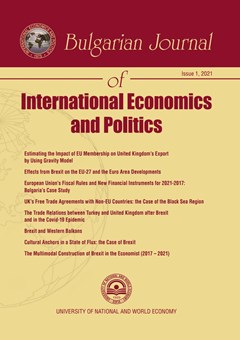
European Union’s Fiscal Rules and New Financial Instruments for 2021- 2027: Bulgaria’s Case Study
DOI:
https://doi.org/https://doi.org/10.37075/BJIEP.2021.1.03Keywords:
EU Integration, Fiscal Rules, Financial InstrumentsAbstract
Fiscal policymaking of the Member States aims to follow fiscal rules through the economic cycle that ensure macroeconomic sustainability in the European Union (EU). After the 2008 global crisis, the Stability and Growth Pact introduced the enhanced supranational fiscal rules, setting additional boundaries to fiscal deficits and government debt. The new ceiling on the structural deficit in public finance laws of Member States has served to protect creditworthiness. The COVID-19 pandemic, which led to a temporary suspension of the fiscal rules, clearly indicates that the key challenges are to implement a countercyclical policy during upturns, building buffers for bad days. Under the Next Generation Europe’s initiative the European Commission (EC) will borrow up to €750 billion and distribute it over 2021-2024 to Member States (European Commission, 2020a). Raising funds in the EU budget and repayment of the EC debt may lead to amendments to the design and application of the EU fiscal rules. This paper lays out the objectives of the EU current fiscal framework and its main pillars, discusses how the EC new financial instruments for the period 2021-2027 will be accounted for in the Member States’ fiscal framework, and what are its possible changes and challenges after Covid-19 and Brexit.References
European Parliament and Council of the European Union (2013). Regulation (EU) No 473/2013 of the European Parliament and of the Council of 21 May 2013 on common provisions for monitoring and assessing draft budgetary plans and ensuring the correction of excessive deficit of the Member States in the euro area. Official Journal of the European Union. URL: https://eur-lex.europa.eu/legal-content/EN/TXT/?uri=CELEX:32013R0473
Blanchard O., Leandro A. and Zettelmeyer J (2021). Redesigning EU Fiscal Rules: From Rules to Standards. Working Paper, 21-1. URL: https://www.piie.com/publications/working-papers/redesigning-eu-fiscal-rules-rules-standards (accessed 2021-05-06)
Claeys G., Darvas Z. and Leandro A (2016). A proposal to revive the European Fiscal Framework. In: Bruegel Policy Contribution, Policy Contribution No. 2016/07. URL: https://www.bruegel.org/policy-brief/proposal-revive-european-fiscal-framework (accessed 2021-05-16)
Council of the European Union (2011). Council Directive 2011/85/EU of 8 November 2011 on requirements for budgetary frameworks of the Member States. Official Journal of the European Union. URL: https://eur-lex.europa.eu/legal-content/EN/TXT/?uri=CELEX:32011L0085 (accessed 2021-05-09)
Council of the European Union (2011). Council Regulation (EU) No 1177/2011 of 8 November 2011 amending Regulation (EC) No 1467/97 on speeding up and clarifying the implementation of the excessive deficit procedure. Official Journal of the European Union. URL: https://eur-lex.europa.eu/legal-content/EN/TXT/?uri=CELEX:32011R1177 (accessed 2021-05-09)
Darvas Z., Martin Ph. and Ragot X (2018). The economic case for an expenditure rule in Europe. The Economic Case for an Expenditure Rule in Europe. URL: https://cepr.org/voxeu/columns/economic-case-expenditure-rule-europe (accessed 2021-05-12)
Council of the European Union (2020). A Recovery Plan for Europe. URL: https://www.consilium.europa.eu/en/policies/eu-recovery-plan/ (accessed 2021-05-16)
European Commission (2020). Autumn 2020 Economic Forecast: Rebound Interrupted as Resurgence of Pandemic Deepens Uncertainty. URL: https://economy-finance.ec.europa.eu/publications/european-economic-forecast-autumn-2020_en (accessed 2021-05-16)
European Commission (2021). Budget correction mechanisms. [Online]. Available at https:// ec.europa.eu/info/strategy/eu-budget/long-term-eu-budget/, 2014-2020. URL: https://commission.europa.eu/strategy-and-policy/eu-budget/long-term-eu-budget/2014-2020/revenue/own-resources/correction-mechanisms_en (accessed 2021-05-16)
European Commission (2020). Medium-Term Budgetary Objectives (MTOs). URL: https://economy-finance.ec.europa.eu/economic-governance-framework/stability-and-growth-pact/preventive-arm-prior-2024/medium-term-budgetary-objectives-mtos_en (accessed 2021-05-16)
Paliova, I. (2021). "Bulgaria's Fiscal Sustainability and Policy Response to the COVID-19 Outbreak". Global Economic Observer, 9(1), 31-38. URL: https://www.globeco.ro/wp-content/uploads/vol/split/vol_9_no_1/geo_2021_vol9_no1_art_004.pdf (accessed 2021-05-16)
Pekanov, A. and Schratzenstaller, M. (2020). The Role of Fiscal Rules in Relation with the Green Economy. [Online]. etudes/STUD/. URL: https://www.europarl.europa.eu/RegData/etudes/STUD/2020/614524/IPOL_STU(2020)614524_EN.pdf (accessed 2021-05-13)
European Parliament and Council of the European Union (2011). Regulation (EU) No 1173/2011 of the European Parliament and of the Council of 16 November 2011 on the effective enforcement of budgetary surveillance in the euro area. Official Journal of the European Union. URL: https://eur-lex.europa.eu/legal-content/EN/TXT/?uri=CELEX:32011R1173 (accessed 2021-05-18)
European Parliament and Council of the European Union (2011). Regulation (EU) No 1175/2011 of the European Parliament and of the Council of 16 November 2011 amending Council Regulation (EC) No 1466/97 on the strengthening of the surveillance of budgetary positions and the surveillance and coordination of economic policies. Official Journal of the European Union. URL: https://eur-lex.europa.eu/legal-content/EN/TXT/?uri=CELEX:32011R1175 (accessed 2021-05-12)
Ministry of Finance of the Republic of Bulgaria (2020). Updated Medium-Term Budgetary Forecast for the Period 2021–2023: Motives to the State Budget Act for 2021. URL: https://www.minfin.bg/en/4 (accessed 2021-05-16)
Downloads
Published
Issue
Section
License
Copyright (c) 2021 Iana Paliova (Author)

This work is licensed under a Creative Commons Attribution 4.0 International License.
Authors retain copyright to their works.
All publications are distributed under the terms of the Creative Commons Attribution 4.0 International (CC BY 4.0) license.