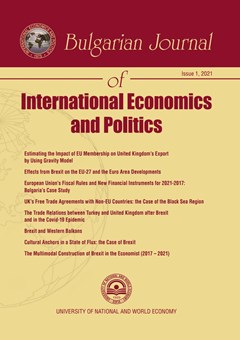
Estimating the Impact of EU Membership on United Kingdom’s Export by Using Gravity Model
DOI:
https://doi.org/https://doi.org/10.37075/BJIEP.2021.1.01Keywords:
United Kingdom’s export, EU membership, Free Trade Agreements, Gravity model, BrexitAbstract
After a year from the formal UK withdrawal from the EU, there are still different opinions about the potential economic impact of Brexit. This paper gives a detailed overview of the trade profile of UK and explores the determinants of United Kingdom`s export. We apply the gravity model to estimate the aggregate benefits of EU membership or the reversed, lost (foregone) benefits from leaving the EU. We measure the influence of GDP, distance, population, the EU membership, and signed free trade agreement with the trading partners on UK’s export as a dependent variable. The analysis includes data for 70 UK trading partners in a period of 48 years (from 1973 to 2020) since Great Britain become EU member. The results show that UK’s export is directly proportional to trade partner’s GDP and inversely proportional to distance. In order to estimate the average benefit due to EU membership, we estimated subsequent equations with different time periods. The coefficient decreases and becomes negative as we shorten the time periods, proving that the average trade advantage due to EU membership diminishes over time. According to the economic theory of regional integration, it is expected that the coefficient increases due to many rounds of enlargement, especially the biggest one in 2004 as well as due to the introduction of the Euro. On the contrary, as we shorten the time periods in the analysis, we obtained increasing coefficient for the variable free trade agreements. This confirms that trade exchange within FTA has significantly higher effect on United Kingdom’s export in comparison with trade within EU.References
Anderson, J. E. and Wincoop, E. V. (2003). "Gravity with gravitas: A solution to the border puzzle". American Economic Review, 93(1), 170--192. URL: http://www.jstor.org/stable/3132167 (accessed 2021-09-14)
Almog, A., Bird, R. and Garlaschelli, D (2019). "Enhanced gravity model of trade: reconciling macroeconomic and network models". Frontiers in Physics, 7, 55. DOI: https://doi.org/10.3389/fphy.2019.00055
Berthou, A., Haincourt, S., de la Serve, M., Estrada, A., Roth, M.A. and Kadow, A (2019). "Assessing the macroeconomic impact of Brexit through trade and migration channels". Documentos Occasionales 1911, Banco de España. URL: https://www.bde.es/f/webbde/SES/Secciones/Publicaciones/PublicacionesSeriadas/DocumentosOcasionales/19/Files/do1911e.pdf (accessed 2021-09-14)
Bergstrand, J.H (1985). "The gravity equation in international trade: some microeconomic foundations and empirical evidence". The review of economics and statistics, 67(3), 474--481. DOI: https://doi.org/10.2307/1925976
Bisciari, P (2019). "A Survey of the Long-Term Impact of Brexit on the UK and the EU27 Economies". Working Paper Research.
Campos, R. and Timini, J (2019). "An Estimation of the Effects of Brexit on Trade and Migration". Documentos Occasionales 1912, Banco de Espana. URL: https://www.bde.es/f/webbde/SES/Secciones/Publicaciones/PublicacionesSeriadas/DocumentosOcasionales/19/Files/do1912e.pdf (accessed 2021-10-05)
Cappariello, R., Franco-Bedoya, S., Gunnella, V. and Ottaviano, G (2020). "Rising protectionism and global value chains: quantifying the general equilibrium effects". ECB Working Paper Series. URL: https://www.ecb.europa.eu/pub/pdf/scpwps/ecb.wp2360~0b2894ed2d.en.pdf (accessed 2021-10-12)
Dhingra, S., Huang, H., Ottaviano, G., Pessoa, J. P., Sampson, T. and Van Reenen, J (2017). "The Costs and Benefits of Leaving the EU: Trade Effects". CEP Discussion Paper.
Gudgin, G., Coutts, K., Gibson, N. and Buchanan, J. (2017). "The Role of Gravity Models in Estimating the Economic Impact of Brexit". Gee Papers, Numero 77(Agosto de 2017). URL: https://econpapers.repec.org/scripts/redir.pf?u=https%3A%2F%2Fwww.gee.gov.pt%2FRePEc%2FWorkingPapers%2FGEE_PAPERS_77.pdf;h=repec:mde:wpaper:0077 (accessed 2021-07-10)
Helpman, E., Melitz, M. and Rubinstein, Y. (2008). "Estimating trade flows: Trading partners and trading volumes". The Quarterly Journal of Economics, 123(2), 441--487. DOI: https://doi.org/10.1162/qjec.2008.123.2.441
IMF (2016). "United Kingdom: Selected Issues". IMF Country Report. URL: https://www.imf.org/external/pubs/ft/scr/2016/cr16169.pdf (accessed 2021-07-07)
Kierzenkowski, R., Pain, N., Rusticelli, E. and Zwart, S (2016). "The Economic Consequences of Brexit: A Taxing Decision". OECD Economic Policy Paper, April 2016(No. 16), OECD Publishing.
Mulabdic, A., Osnago, A. and Ruta, M. (2017). "Deep Integration and UK-EU Trade Relations". World Bank Policy Research Working Paper. DOI: https://doi.org/10.1007/978-3-319-55495-2_10
OEC (2019). Country Profile. The Observatory of Economic Complexity (OEC). URL: https://oec.world/en/profile/country/ (accessed 2021-07-14)
Pisani, M. and Caffarelli, F. V (2018). "What will Brexit mean for the British and euroarea economies? A model-based assessment of trade regimes". Temi di discussione (Economic working papers), Bank of Italy, Economic Research and International Relations Area.
Tinbergen, J. (1962). Shaping the world economy; suggestions for an international economic policy. " [Online]. (last visited May. URL: https://archive.org/details/shapingworldecon0000tinb/page/n7/mode/2up (accessed 2021-05-11)
Vandenbussche, H., Connell, W. and Simons, W. (2017). "Global Value Chains, Trade Shocks and Jobs: An Application to Brexit". CEPR Discussion Papers. URL: https://hdl.handle.net/10419/198833 (accessed 2021-05-12)
Downloads
Published
Issue
Section
License
Copyright (c) 2021 Elena Disoska, Katerina Toshevska-Trpchevska, Irena Kikerkova, Jasna Tonovska (Author)

This work is licensed under a Creative Commons Attribution 4.0 International License.
Authors retain copyright to their works.
All publications are distributed under the terms of the Creative Commons Attribution 4.0 International (CC BY 4.0) license.